
A little bit of history
Thank you to the members who organized our centennial events and published the history of St. Paul’s up to 1997. Many of you are still sitting in the pews today.
It is hard to believe that 29 years have passed since that milestone.
Our Roots and Construction
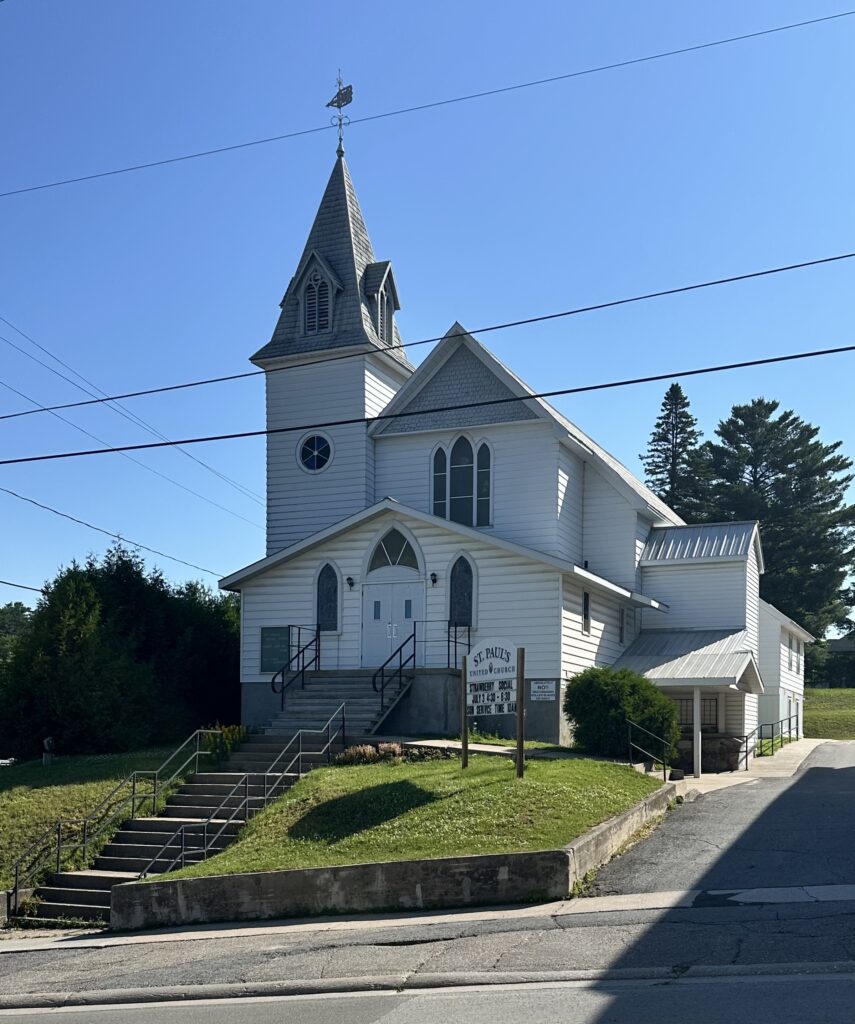
Long before St. Paul’s stood on this site, an 1870 community church just up the road served as a shared gathering place where all denominations worshipped while waiting for their own churches to be built. Then, in 1897, St. Paul’s made its appearance as a beacon on the hill overlooking the Town of Bancroft. The land was generously donated by Senator Billa Flint, an ardent Methodist.
Yet St. Paul’s almost wasn’t built here at all. Under the Liquor Licensing Act of 1887, a church could not be erected within 300 feet of a licensed establishment, and you only need to look kitty-corner from our building to see the issue. Fortunately, the Methodist Church signed an agreement not to object to the sale of alcohol, allowing the work to go forward.
Contractor William A. Davy and his brothers built the original structure with North American Gothic frame construction and crafted the pulpit and pews at their own furniture factory. Inside, wall-bracketed oil lamps lit the sanctuary, while a dove, the Methodist symbol, was painted on the domed ceiling above the chancel. A circular staircase led down to a wood-burning furnace in the basement. On the west side, a kitchen held a temperamental cast-iron stove for when the Ladies Aid catered, with water carried in from a distant well. On October 3, 1897, Rev. S.J. Shorey, a former president of the Bay of Quinte Conference, led the dedication service.
Twentieth-Century Growth
Over the decades, renovations and improvements continually shaped the building. The church was wired for electricity in 1931, and town water and sewer became available in 1957. In 1954, major work extended the east side to enlarge the choir loft, added a vestry on the north side, and created a combined choir and board room on the south. That same year, the basement was enlarged for a new kitchen, furnace, and washrooms, alongside updated sanctuary lighting. The Afternoon Women’s Association had already set aside a sizeable sum, most likely to help furnish the new extension, and today our UCW continues to support the church through various fundraising events.
Growth continued into the next chapter when St. Paul’s purchased the Community Hall in 1959 to serve as the Christian Education Centre, a building now known as the Bancroft Village Playhouse. Used for Sunday School and youth groups, it saw Sunday School enrollment reach just shy of 200 youth through the 1960s. Later, the 1980s brought stained glass memorial windows to replace most of the original windows. In 1990, the cemetery on the hill behind the parking lot officially closed; although it has been over 120 years since anyone was buried there, visitors who walk into the cemetery can still see a cairn bearing notable Bancroft and St. Paul’s names. Two years later, in 1992, another expansion eased congestion in the original vestibule and created our enlarged narthex, a welcoming space to chat and enjoy a coffee before church.
St. Paul’s Since 2000
Since 2000, the story of St. Paul’s has continued through practical care, resilience, and enduring voices.
In 2015, the old electric stair chair was replaced with the current lift, an upgrade many have ridden in over the years.
Music has also remained central to church life. While we no longer have the choir that sang here before the pandemic, the Joy Club ensemble has stepped in to fill that gap.
In the 1997 Centennial book, Barb Laundry noted two voices that had already been around for almost 25 years. Today, Nancy Bruce and Joan Kelly have been lending their voices to St. Paul’s and Joy Club for over 50 years.
“I am the church. You are the church. We are the church together.”
Barb Laundry